

Beyond the Board: The Secret World of Sudoku
Exploring puzzle culture and looking at lessons for game design

This is from the ‘Beyond The Board’ series, which highlight moments in gaming when the emotional experience elevated, or demoted, a game beyond the experience of the board.
One question I remember being asked during one of my many, many unnecessary studies, was to ask about the media worlds we inhabit. What communities and cultures do we encase ourselves within and interact with day to day. This is a great question to ask someone you know well or someone you’ve only just met - what parts of the internet do you find yourselves relaxing into? There’s probably more normal ways to ask that but by golly, this is a Substack essay, and if above anything else, I’ve got to sound smart.
Now on one level, the social media you interact with says a lot about who you are and how you relate to other people. I know many people who flocked to instagram and that was their thing, because of its visual simplicity; similarly, there are folk I know who found themselves dipping back into twitter, because it was caustic and engaged politically. To an extent this is interesting, but it the enclaves within these spaces that I am talking about - these interest niches tell you a lot about a person, and finding out about those worlds is something I find endlessly fascinating and a brilliant conversation starter.
There was one world throughout the pandemic that YouTube kept dangling in front me and which I resisted for a long time - sudoku-tube. I love puzzles, and despite my artsy background, I boomerang back time and again to the security of maths, and the wonder of engineering. There is something powerful about the certainty that science and numbers provide - and a sublime power when even these powerful, objective forces are left wanting.
Now, vanilla sudoku intrinsically isn’t really maths-y at all. It’s a spatial puzzle at its heart, it’s just that it uses digits we all know and love1 as an iconography for simplicity - so anyone can tap into its placement rules. However, between 2002-2005, or so it felt, pen and paper sudoku took over the world for this very reason - it used the lexicon of mathematics to appear intellectual, while using the building blocks that are taught at a pre-school level as its language of interaction. Even the humble crossword - the apparent literary partner to sudoku - cannot satisfy an international public the way that sudoku can because it faces barriers to entry.2 But, the success of the simple sudoku lead boffins at sudoku central to start tinkering with the formula and produce similar puzzles and challenges to sate a hungry audience.
I’d like to make it clear that I am no sudoku historian, and I doubt that is a title that anyone puts on their tax form. However, from memory, the next stop on our story is to the killer sudoku. These sudokus bring mathematical interest to the fore, adding dotted boxes within the famous grid, grouping unknown numbers together that some to a given total, an additional clue - pun intended. It is through limiting the possibilities of adding three different digits to a total and then excluding these from other clues that take the player on a journey. These however, were still intended to be solved with a pen and paper, and from my understanding were created by machine, that is a formula which prints these fuckers out.
🎲 🎲 🎲 Design Prompt: Take a game you already know and try to build a new puzzle or ‘level’ for it, or think through how the set content it already has, works 🎲 🎲 🎲
Now, let’s move sudoku on 20 years.
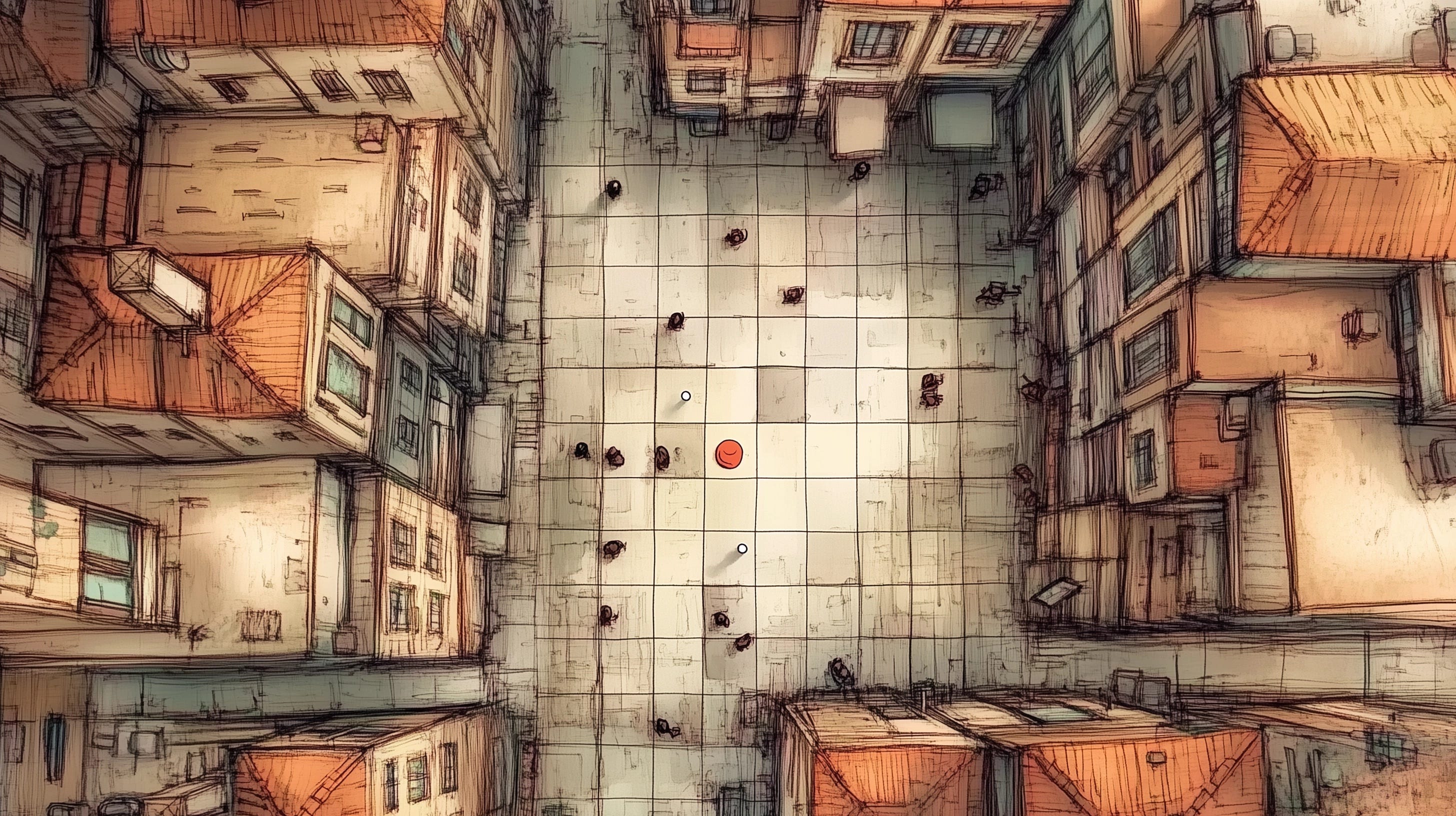
Exactly what moved the genre on, I’m not strictly certain but I’d hazard a guess that the move to digital certainly helped things. For one, a more standardised notation system - one which enabled the use of colour to take the place of digits for example - allowed for a more flexible approach to puzzle solving, and you could make errors without ruining the puzzle. Similarly, having answers checked as you go, exploring relationships between digits as they are selected, and the possibility of cheap, full colour puzzle creation all make digital sudoku a more viable proposition.
But in its latter years, it is the addition of video which has spurred unprecedented interest in the genre, and in response, an arms race by setters to curate more complex and interesting mechanisms for puzzlers to solve. This is because the spectacle of watching some of the great sudoku masters tackle a daily puzzle, really is something to behold. You can see brains pulsating as they circle round the grid, looking for an in.
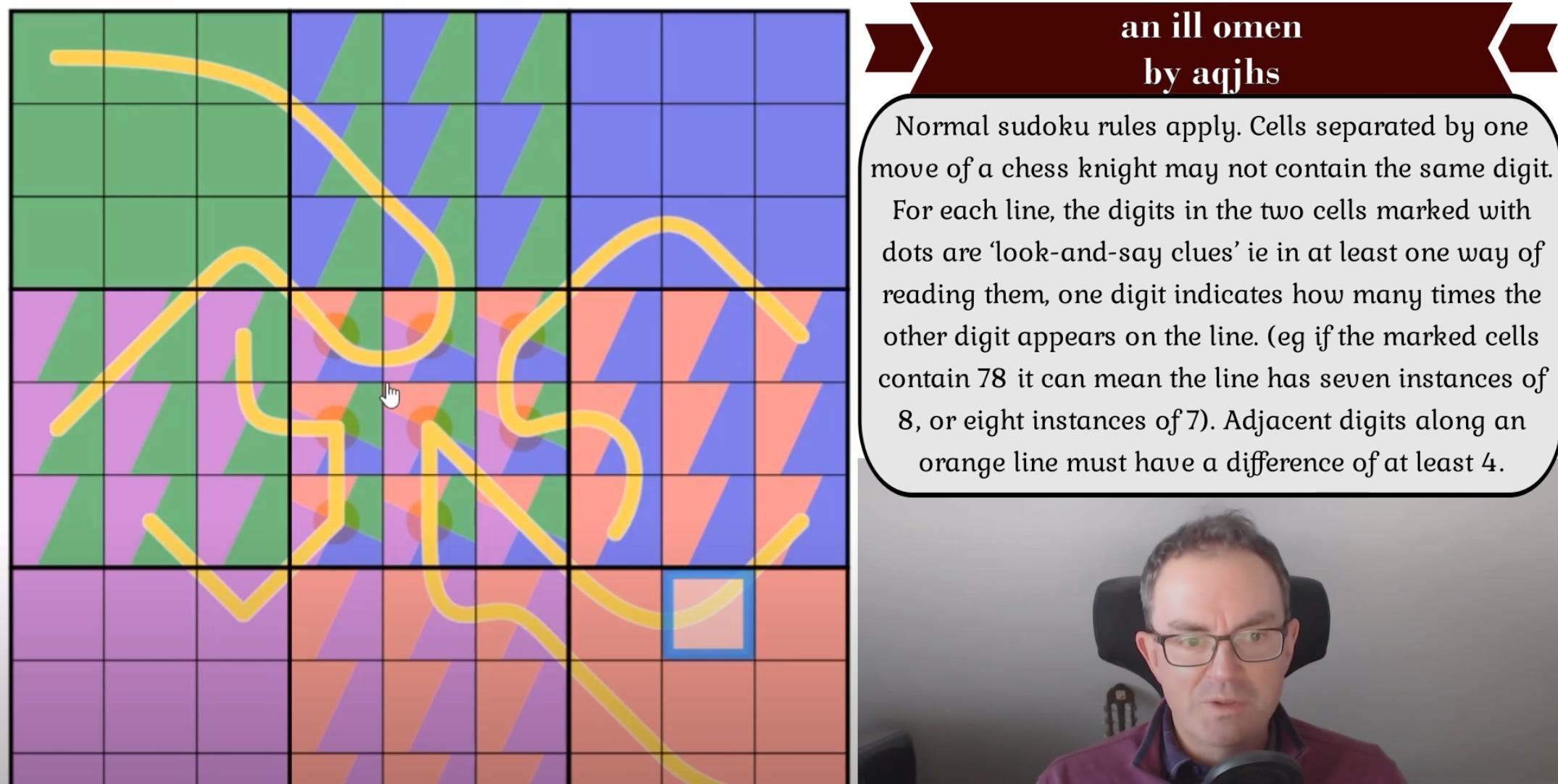
Let me get something straight here - these puzzles are tough. For one, there are few (if any) given digits to kick things off, just a cryptic language of symbols and lines which keen viewers won’t need an explainer to understand, but to the layman it’s alien. You have renban lines (consecutive numbers on this line ), kropki dots (black dots signify one cell is a double of the other), sandwich variants (the sum of digits between the 1 and 9 in a given row or column), region sum lines (the sum of digits in each region on a line must be the same), thermometers (numbers along a line increase from the ‘bulb’), arrow lines (digits on a line must sum to the circle digit) and skyscraper clues (the digits represent the height of buildings). And then there are the more bold distractions to the basic 9 x 9 grid - larger grids where you have to determine where each region is, or more popularly fog puzzles where the entire puzzle is hidden by fog which is only removed when a correct answer is given in specific cell. It really is quite an extraordinary collection of ideas which continue to develop and evolve as puzzles are played on screen and a new idea pops into the culture, later re-used in a curious way which seems to expose some truth to the nature of sudoku, but this knowledge seems to be, outside of this world, useless (and more power to them).
There is with these designs, a knowledge, that allows a player to be taken step by step through the solve: what seems impenetrable is slowly eroded as a logical determination here permits another logical determination there, and before long… you’ve done it, you’ve cracked it, a first digit! And on it goes - quite how this is achieved by the setters, such that you are railroaded through a solution on a single track I cannot for the life of my fathom, as my brain is not the size of a planet as theirs appear to be. However, it is achieved with such remarkable repeatability, and in puzzles which are almost literally thrown away for no other purpose than an hour’s frivolities, that the mind boggles at the expertise and intellect being focused on this endeavour. But so what?
Enter, Cracking The Cryptic.
Cracking The Cryptic
Cracking The Cryptic is a very special community. Mainly consisting of two senior sudoku locksmiths - Mark Goodliffe and Simon Anthony - the channel churns through puzzles at a rate of at least 14 puzzles per week.3 Long videos, rarely shorter than 50 minutes, mutually engaged with a more broad puzzle world - see for example the stupendous source that is logic-masters.de - brim with personality and mathematical curiosity which keep you pinned to the screen.
But for their apparent skill and the impenetrability of the puzzles before them, the daily show is wonderfully joyous and amiable. As hosts they are warm and inviting - any video can be your first, Simon especially makes pains to explain every rule and solve technique - and in so doing invites you into his close cohort of chums who he would bore at parties with a little sudoku secret that pops up in almost every video. When more advanced techniques are on display, you are in for a treat, with scrabble tile bags at the ready.
There is a touch of the old BBC Broom Cupboard to proceedings, as each video begins with announcements, birthdays and correspondents, reliably filling you in on their world but also giving the audience a platform to share achievements and life stories from theirs.4 Though we fall short of birthday cards and hand puppets, there are a small host of characters which provide texture, including the inevitable interruption by maverick, a plane that sounds like a spitfire roaring through across the skies, or the hopeful arrival of a 3 being placed in the corner of the puzzle which leads to some makeshift REM.
However, I don’t just like this channel, dear reader. This series of blogs, Beyond the Board, is about moments that surpass what is provided by the rules of a game that make playing something greater than the some of its parts. I think the advances in sudoku are well worth discussing in game design terms, and of interest to the board game community at large - but it is the emotional journey that this framework provides which I find fascinating. And yes, it is as much about the community around playing these puzzles as it is the games themselves, which should be enough of a revelation when it comes to the design of your game; but there is enough in the evolution of a language to convey emotional ideas through sudoku that also make this worth looking into.
🎲 🎲 🎲 Design Prompt: How could you design a game that was as fun to watch being played as it is to play? How could you use video, or social media, or any digital community to contribute and reflexively interact with your project? 🎲 🎲 🎲
And it is not limited to a single moment I might add. The Cracking The Cryptic videos quite reliably provide joyful or inspiring moments that you would not expect from a channel which may only appeal to quite a niche audience. I have provided some links of interest for various reasons, but I will develop one specific moment if you’ll permit me.
Some key videos to watch:
The Miracle Sudoku (YouTube)
A puzzle in which the only clue is a single line (YouTube)
Simon explains the Phistomophel Ring on Numberphile (YouTube)
A 4 x 4 Sudoku Grid with an hour solve (YouTube)
A sudoku using decimals (YouTube)
The Caterdokupillar solved live (YouTube - 8 hours over 4 videos)
The ongoing Rat Race Maze series (YouTube)
Interpreting racial inequality through the lyrics of Tracy Chapman via sudoku (YouTube)
The strength most obvious to explaining this quality is the personnel involved. Our prime time daily host Simon goes under the monicker of a former UK Sudoku Champion - I have not for a moment checked his credentials, and have even less idea what competitive sudoku would even look like, other than an exam hall with a big clock on the wall as everyone races to complete a sudoku as quick as they can before slamming down the button of a chess clock and raising a hand in the air triumphantly with the correct solution aloft. But he is, as far as I’m concerned, the people’s sudoku champion. He is so good. As a person, as an orator, and as a teacher, he calmly delights in the world of any given puzzle for as long as it takes. Mild-mannered and logically passionate about logic, Simon has a very enigmatic appeal for a very specific kind of person.
But daily, these people reach out. I will not forget the day that Simon read aloud an email he received of a father who watched the videos almost religiously as he passed the time in hospital waiting rooms, as his son received life saving surgery. It is not often that a YouTube video brings one to tears, and Simon was visibly moved. For that moment each day, peace could enter that man’s life and the stresses of the world around him could disappear to let him pass through the darkest pits of tedium. There is undeniably something habitually religious about this channel - like a vicar checking in on his congregation. It is not in any way messianic you understand, this isn’t some strange cult I am leading you towards.
Staring into a sudoku for hours on end, the answer to which is inevitably a series of digits 1-9, is a surprisingly cathartic and almost transcendental experience. It is like you are staring into the depths of the universe, looking at the fabric itself. Any given sudoku feels like a molecular recipe that someone has discovered, and there is only one logical way those molecules can be arranged. But the simple act of watching and engaging with the distraction for long enough can be as meditative and soul enriching as a good chicken soup.
🎲 🎲 🎲 Design Prompt: Who are you as a person and how is that personality visible in your design? Do you consider your fingerprint in game design to be a hinderance or a strength - and how can you further embellish this in your next design? 🎲 🎲 🎲
I don’t know what else I can say about this world without forcing you into it. It is a fascinating hobby, and I believe a rewarding experience to be part of. But enter of your free will, and see what you find.
As ever, if you want to contribute something you’ve experienced playing games that exceed the board, I’d love to hear from you, please send me a message on here.
From oh so reliable ‘1’ to the sexually cheeky ‘6’ and its always up-for-it partner ‘9’. Happy to go through a full rundown of what each digit means for anyone in the comments
Even within the English language there are variations on the form between the UK and the US, and further the quick vs cryptic. Hell, even between papers in the UK and between setters within a single publication, a crossword changes its expression.
That’s 14 pp/w I suppose. I’d be interested to hear their ‘puzzles per hour’ (pp/h) stats based on the length of each solve.
This includes the proud moment where the birth of my daughter gets a shout out for being born at the least prime time I could imagine, 10:24 am. My wife, on hearing this was as equally embarrassed as she was confused, not helped by the fact that she was recovering at home from the equally impressive act of giving birth to an actual human being.